

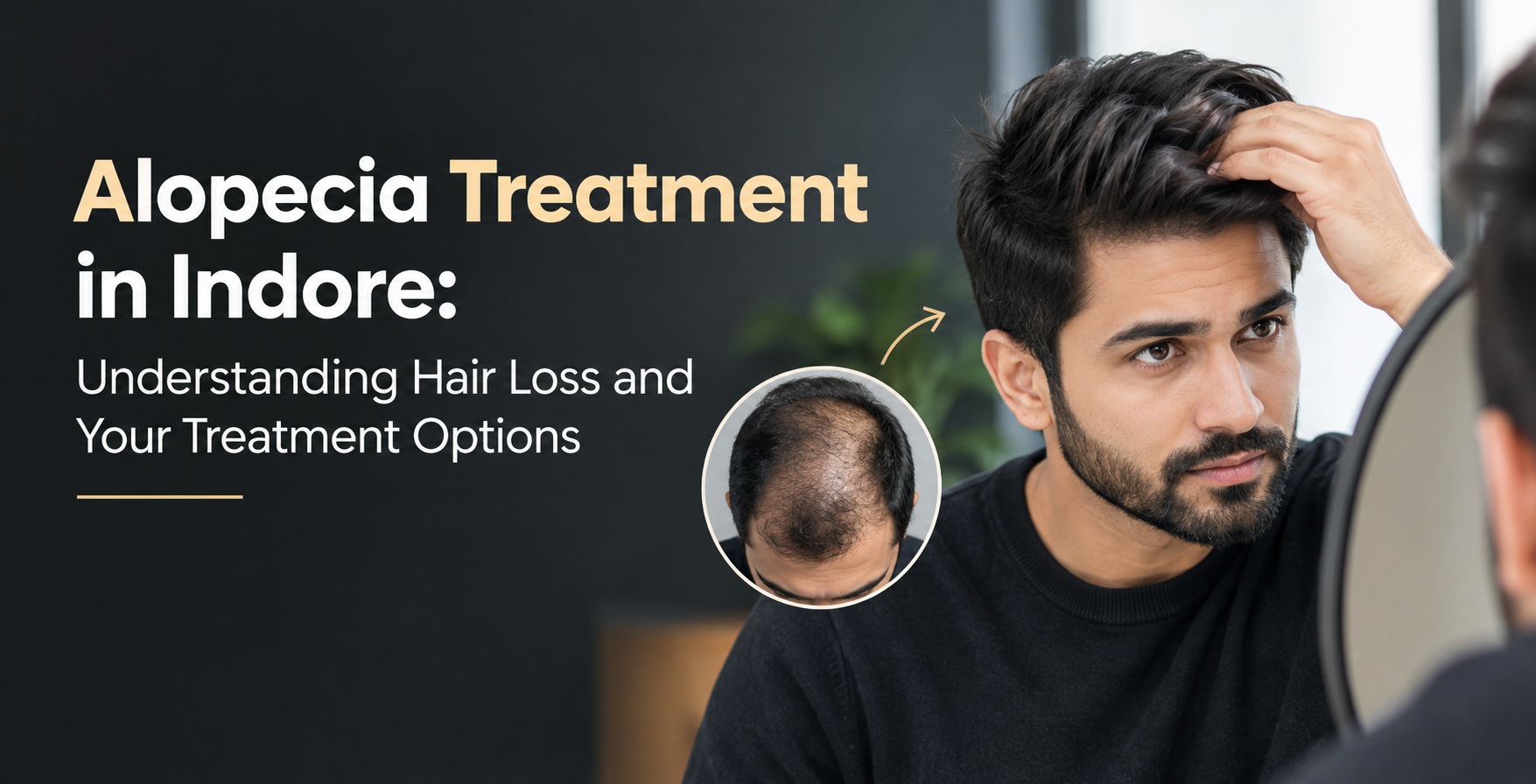
Finding a bald patch while combing your hair can be worrying. For some people, the loss may be limited to a small area, while others may notice progressive thinning across the scalp. When hair disappears in an unusual pattern or continues to fall despite normal hair care, it is worth finding out what is actually happening.
Alopecia is a general term used to describe hair loss. It can develop for many different reasons, and the appearance of the hair loss can vary from person to person. This is why people looking for alopecia treatment in Indore should first focus on identifying the type of alopecia rather than choosing a treatment simply because it worked for someone else.
What Does Alopecia Mean?
Alopecia simply means loss of hair. It does not describe one particular disease.
Hair may be lost from the scalp, beard, eyebrows, eyelashes, or other parts of the body. In some cases, the follicles remain capable of producing new hair. In others, prolonged inflammation or scarring can affect the follicles more permanently.
The pattern of hair loss often provides useful clues. Sudden round patches, gradual thinning, a receding hairline, and hair loss accompanied by scalp irritation can point toward very different conditions.
Why Does Alopecia Happen?
Hair growth is influenced by genetics, hormones, immune activity, nutrition, general health, and the condition of the scalp. A disturbance in any of these areas can affect the normal hair-growth cycle.
Some possible contributors include:
- Autoimmune activity
- Hereditary hair-loss patterns
- Hormonal fluctuations
- Certain nutritional deficiencies
- Physical or emotional stress
- Some medicines or medical treatments
- Scalp infections
- Inflammatory scalp conditions
- Repeated pulling or tight hairstyles
- Certain chronic health conditions
It is therefore not always accurate to blame hair loss on stress or poor diet alone. The underlying reason needs to be established before deciding how to manage it.
Different Forms of Alopecia
Alopecia Areata
This type of hair loss often appears unexpectedly. A person may notice a smooth, clearly defined patch where hair has disappeared. It can occur on the scalp as well as the beard, eyebrows and other areas.
The amount of hair loss can range from a few isolated patches to much more widespread loss. Some individuals may experience regrowth, while others can have recurring episodes.
Pattern Hair Loss
Pattern hair loss tends to develop gradually and is strongly influenced by genetics.
Men may notice thinning around the temples or crown, whereas women may see reduced density around the central parting. Because this form progresses differently from patchy alopecia, its treatment approach is also different.
Traction Alopecia
Hair that is repeatedly pulled tight can place excessive stress on the follicles. Frequent use of very tight hairstyles, extensions, or similar practices may contribute to traction-related hair loss.
Changing the hairstyle and reducing tension early can be important in preventing further damage.
Scarring Alopecia
Some scalp disorders can produce inflammation that damages the hair follicle and eventually results in scarring.
This category deserves particular attention because once a follicle is significantly scarred, normal hair production may not return. Early professional assessment is therefore particularly valuable when hair loss is accompanied by persistent redness, scaling, pain or other scalp changes.
Signs That Your Hair Loss Needs Professional Attention
Normal shedding does not necessarily mean that you have alopecia. However, certain changes deserve closer attention.
You may want to arrange a hair and scalp evaluation if you notice:
- A bald patch appearing without warning
- Hair loss becoming noticeably faster
- Increasingly visible scalp
- Loss of eyebrow or beard hair
- Persistent itching or irritation
- Redness, scaling or tenderness on the scalp
- Hair breaking unusually close to the scalp
- Changes in the nails along with patchy hair loss
Taking photographs of the affected area over several weeks can also help you and your specialist notice whether the pattern is changing.
How Is Alopecia Identified?
Alopecia cannot always be identified simply by looking at the amount of hair in your comb.
During an examination, a hair specialist or dermatologist may look at the scalp, hair shafts, and affected areas in detail. They may also ask when the problem began, whether the loss was sudden or gradual, whether similar problems occur in the family and whether you recently experienced illness, significant stress or changes in medication.
Depending on the suspected cause, additional investigations may be suggested.
These could include blood tests or, in selected cases, examination of a small scalp sample. The purpose is to distinguish between conditions that can look similar but require different management.
Alopecia Treatment in Indore: What Options Are Available?
There is no universal alopecia treatment that suits everyone. The treatment plan depends on the diagnosis, extent of hair loss, condition of the follicles and the individual’s response to treatment.
Some commonly considered approaches include the following.
Topical Treatments
Certain topical medicines can be used for specific forms of hair loss. Their purpose may be to support hair growth, reduce inflammation or address another underlying scalp problem.
The medicine selected should match the diagnosis rather than simply being chosen as a general hair-growth product.
Oral Medicines
In selected cases, a dermatologist may recommend oral medication.
The type of medicine depends heavily on the cause of hair loss. Because some medicines can have side effects or interact with other treatments, self-medication is not advisable.
Corticosteroid-Based Treatment
For some patients with alopecia areata, corticosteroids may be considered to control the inflammatory or immune response affecting the follicles.
Depending on the situation, treatment may involve a topical preparation or injections administered by a medical professional.
PRP for Selected Hair-Loss Conditions
Platelet-rich plasma, commonly known as PRP, is a procedure in which a person’s blood is processed to concentrate platelets before the preparation is used on selected areas of the scalp.
PRP is sometimes included in treatment plans for particular forms of hair loss. It is not a universal solution for every type of alopecia, and the potential benefit depends on the individual case.
Low-Level Light-Based Treatment
Light-based devices are another option that may be considered for certain hair-loss conditions.
These treatments generally require repeated use, and the expected outcome depends on the reason behind the hair loss. A professional assessment can help determine whether this approach is appropriate.
Cosmetic Hair Replacement
Medical treatment may not immediately restore lost density. For people experiencing substantial or persistent hair loss, cosmetic solutions can provide a way to improve appearance while treatment continues.
Depending on the situation, options may include wigs, hair systems or other non-surgical hair-replacement methods.
Can Alopecia Hair Grow Back?
This depends on what caused the hair loss.
In some forms of alopecia, the follicles remain active and hair can return. Other conditions may require longer-term management to encourage or maintain regrowth.
Alopecia areata, for example, can behave unpredictably. One person may experience regrowth after a limited episode, while another may have repeated patches.
This is why promising a fixed recovery time for every patient would be misleading. The realistic timeline can only be discussed after understanding the particular type of hair loss.
Does Alopecia Always Need Treatment?
Not necessarily.
Some mild cases may improve without intensive intervention, while other forms can become progressively worse if the underlying problem is not addressed.
The important question is not simply “How much hair am I losing?” but also “Why am I losing it?”
Once the cause has been identified, you can make a more informed decision about whether observation, medication, a procedure or a combination of approaches makes sense.
How to Choose an Alopecia Specialist in Indore
Searching online for alopecia treatment in Indore can bring up many clinics and treatment claims. Instead of comparing clinics only on advertised procedures, consider the quality of the consultation.
A good hair-loss evaluation should involve:
A proper examination: The scalp and pattern of hair loss should be assessed rather than relying only on a brief conversation.
Cause-based treatment: The recommended approach should relate to the suspected reason for the hair loss.
Clear expectations: You should understand what the treatment is intended to achieve and how long improvement may take.
Discussion of alternatives: If more than one approach is suitable, the advantages and limitations of each should be explained.
Follow-up: Hair growth is gradual, so monitoring changes over time can be useful.
What Can You Do at Home?
Medical treatment is only one part of looking after your hair. Everyday habits can also help protect the hair you still have.
Try to avoid unnecessarily tight hairstyles, excessive heat and aggressive chemical treatments. Handle wet hair gently and maintain a balanced diet that provides adequate protein and essential nutrients.
However, home care should not replace professional evaluation when hair loss is sudden, extensive or accompanied by scalp symptoms.
When Should You Consult a Specialist?
You do not necessarily need to wait until a bald patch becomes large.
If you suddenly notice an unusual area of hair loss, repeated patches, rapidly increasing thinning or changes in the scalp, arranging an evaluation can help clarify the situation.
Early assessment is especially useful when inflammation or scarring may be involved because protecting healthy follicles can become an important part of management.
Frequently Asked Questions
Q. What is the best treatment for alopecia in Indore?
There is no single treatment that works for every type of alopecia. The appropriate option depends on the cause, pattern, and severity of the hair loss.
Q. Can alopecia areata disappear on its own?
Some people experience spontaneous hair regrowth, particularly when the affected area is limited. However, the condition can also return or become more extensive.
Q. Is PRP suitable for every alopecia patient?
No. PRP is considered for selected hair-loss conditions and may not be appropriate for every form of alopecia. A professional assessment is recommended first.
Q. How long does alopecia treatment take?
The duration varies considerably. Hair normally grows slowly, so improvement may take time and depends on the underlying condition and chosen treatment.
Q. Can hair loss from alopecia become permanent?
Some forms can cause lasting follicle damage, particularly certain scarring conditions. Other types may allow partial or complete regrowth.
Conclusion
Alopecia can look different from one person to another, which is why treating every case as ordinary hair fall can lead to the wrong approach. Identifying the pattern, understanding the possible cause and checking the condition of the scalp and follicles are important first steps.
If you are searching for alopecia treatment in Indore, start with a proper evaluation rather than choosing a procedure based solely on advertisements or online testimonials. Once the reason for the hair loss is understood, you can discuss suitable treatment options and realistic expectations with a qualified specialist.
The goal should not simply be to find a quick fix. It should be to understand your hair loss and choose an approach that makes sense for your individual condition.